An experiment in AI and wealth management
So I gave an AI access to a live brokerage account. Not to chase alpha, but to find out what artificial intelligence is actually good for in finance. What I found has less to do with beating the market and more to do with who finally gets a seat at the table.

01 / The question
Almost every conversation about AI in finance is a race to predict prices. I think that’s the wrong race. So I connected an autonomous AI system to a real, sandboxed brokerage account and let it research and propose trades under strict rules.
Not to find a money machine. To pressure-test a more honest question: where does this technology create real value for real people?
02 / The build
I connected Claude to a live, self-funded brokerage account and turned it into something a student could never otherwise access: a personal quant desk. Not a chatbot answering questions. A system that researches, debates, and proposes real positions.
The point was never the money. It was to find out what an AI desk is genuinely good at when it has skin in the game: real prices, real rules, and a human holding the trigger.
Claude wired to a live, agentic brokerage account.
Specialized sub-agents research, value, and stress-test every idea.
Nothing executes without my order-level confirmation.
03 / How the desk works
The desk runs as a team of specialized agents. A screener hunts for candidates; analysts dig into fundamentals and technicals; a macro and catalyst desk sets the backdrop. Then the two that matter most: a red-team whose only job is to argue the bear case, and a risk manager with veto power over every position size.
Every idea is logged with a probability and graded later, so confidence has to be earned, not asserted.
One rule never bends: the AI never places a trade without my explicit, order-level confirmation. Simulate, show, confirm, place. The machine does the work. A human still makes the call.
04 / The thesis
Prices aren’t a math problem with a hidden solution. They’re the live aggregate of fear, narrative, and conviction: reflexive, reactive, and deeply human. An AI can read faster and remember more than any analyst alive, but it can’t stand outside the crowd it’s part of.
I don’t see a future where AI reliably predicts the market. I see a future where it makes everyone inside the market more disciplined.
The edge was never prediction. It’s process: a repeatable way to stay rational when everyone else, the machine included, is tempted not to be.
05 / Where the value is
If you have under about $15,000 to invest, the traditional advice industry mostly isn’t built for you. The minimums are too high, the economics don’t work, and good guidance stays a privilege of people who already have money.
That gap is exactly where AI earns its place. A well-governed system can give that investor something they’ve never had: patient, unbiased, always-available analysis, and more importantly, discipline. Not stock tips. A process they could never afford to rent from a human.
Concretely, that looks less like a crystal ball and more like a junior advisor who never sleeps:
06 / The limit
It can’t build trust. It can’t read the client across the table who’s scared in a downturn. It can’t manage a relationship, hold someone to a plan through a hard year, or replace the judgment of an advisor who knows a family’s whole story.
The future of wealth management isn’t human or AI. It’s an advisor made far more capable by AI: spending less time on spreadsheets, and far more time with people. The machine handles the analysis. The human handles the meaning.
07 / Pressure-testing it
A single student experiment proves very little on its own. So as the project went on, I took what I was finding to people who actually manage money: advisors, analysts, and mentors in the industry. I asked them where my read held up, and where my inexperience was showing.
Some pushed back. Some sharpened the argument. A few changed my mind. The views you have just read are not a hot take from one account in a sandbox. They are my conclusions after weighing my own results against the people who live this work every day.
Where their experience and my findings lined up, I gained conviction. Where we disagreed, I kept the tension on the page instead of smoothing it over. What follows is the view that survived that scrutiny.
08 / My outlook
I’m betting my career on the human side of this business, sharpened by the tools. AI will compress the cost of good analysis toward zero and push real financial guidance down-market, to the people who’ve never had it.
The advisors who win won’t be the ones who resist it, or the ones who hide behind it. They’ll be the ones who use it to serve more people, better.
That is the seat I’m working toward: the advisor who finally reaches the people the old model priced out.
The person behind the experiment
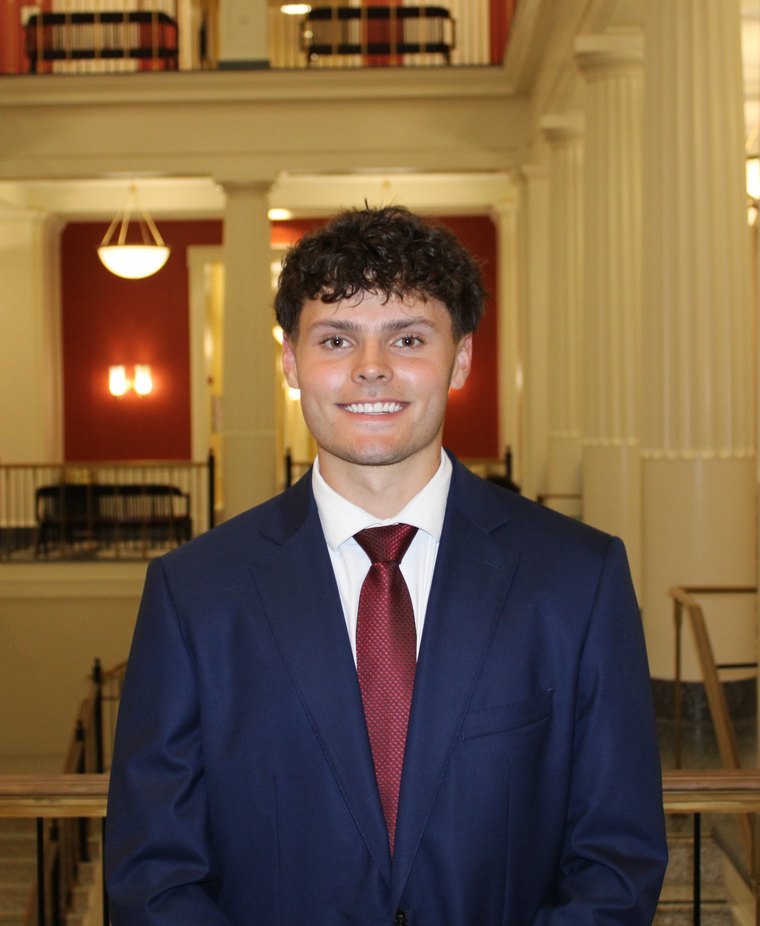
Finance and Entrepreneurship student building toward a career in wealth management, convinced the future of advice is human, sharpened by AI.